

Barcode-Driven Warehouse & Multi-Carrier Shipping
Pick-pack-ship on handheld scanners, wired into three carrier APIs — ~20% more throughput and ~30% fewer manual entry errors.
Client
National Distributor, Paper-Based Warehouse
Industry
Logistics · Warehouse & Fulfilment
Duration
6 months
Year
2025
Background
A national distribution operator was keying warehouse transactions by hand. Stock moves were recorded on paper and entered later, inventory counts drifted from system records between cycle counts, and every outbound shipment meant re-typing address and weight data into a separate carrier portal. Throughput was capped not by people or space, but by data entry.
The Challenge
Warehouse automation touches the two things a distributor cannot afford to get wrong: inventory accuracy and shipment integrity. The programme had to prove barcode-driven transactions on handheld devices, real-time inventory updates, and correct rate calculation and label generation across three separate carrier APIs — each with its own payload format, error semantics and tracking model.
Our Solution
SageWare delivered the functional and QA workstream for the pick-pack-ship rollout. We configured and validated barcode-driven warehouse transactions through handheld devices integrated with Sage X3, then built end-to-end test coverage for order fulfilment, shipment processing, rate calculation, label generation and delivery workflows. Carrier integrations were exercised directly at the API layer in Postman — validating request and response payloads, carrier rates, tracking numbers and error handling — and data synchronisation between Sage X3 and each carrier was verified against live business rules.
Key Deliverables
- Barcode-driven warehouse transactions with real-time inventory updates
- Pick-pack-ship workflows validated on handheld scanning devices
- Three carrier API integrations tested at payload level for rates, labels and tracking
- End-to-end order fulfilment and shipment regression suites across multiple cycles
Results & Impact
How We Did It
01
Operational Walkthrough
Walked the floor with production, planning and warehouse teams to map every physical transaction against its system counterpart and isolate the manual handoffs.
02
Barcode & Handheld Configuration
Configured pick-pack-ship workflows on handheld devices integrated with Sage X3, validating real-time inventory updates against every stock movement type.
03
Carrier API Integration Testing
Exercised three carrier integrations in Postman — validating rate calculation, label generation, tracking numbers, payload contracts and error handling.
04
Fulfilment Regression & Cutover
Ran end-to-end order fulfilment and shipment regression suites across multiple cycles, driving defects to closure for a production-ready release.
Decisions & Trade-offs
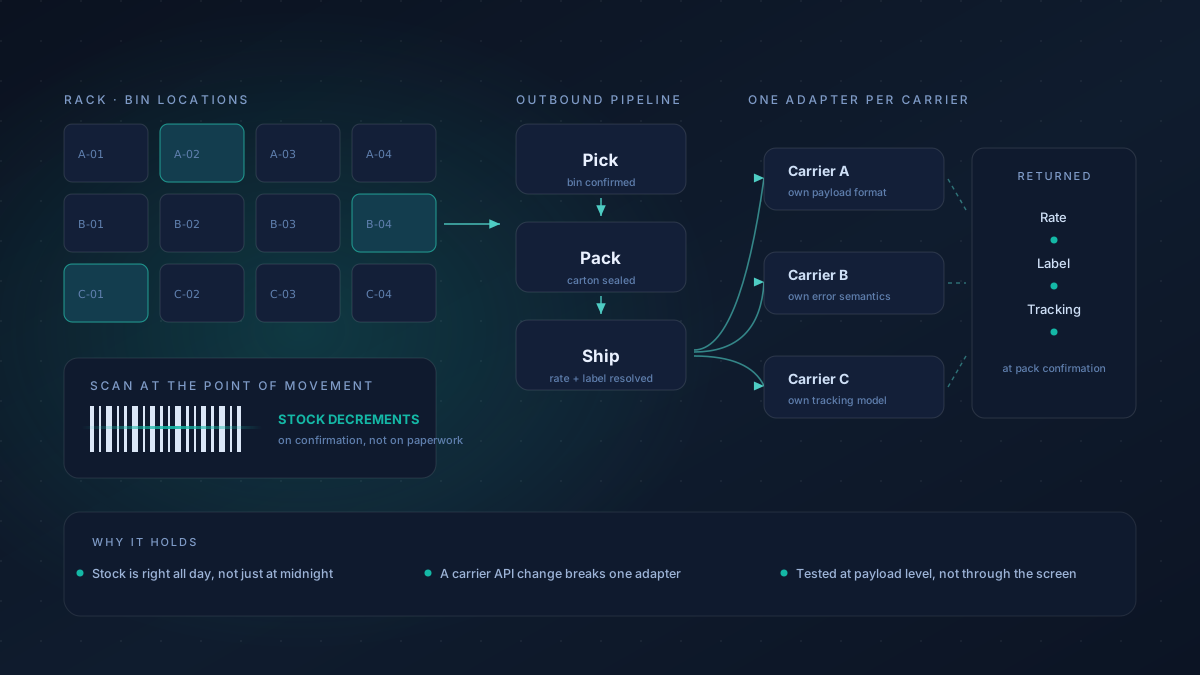
Scan at the point of movement, not after it
The throughput gain does not come from a faster screen. It comes from stock decrementing at the moment a picker confirms a bin, rather than from paperwork keyed in an hour later by someone who was not there. That shifts the burden onto the floor — the device becomes part of the job, and the system now depends on handheld uptime and coverage in a way it did not before. We took that trade because a stock figure that is right at midnight and wrong all day is not a stock figure anyone can plan against.
Exercise carrier integrations at the payload level, not through the screen
Driving a carrier integration through the ERP interface mostly tests the ERP interface. The failures that actually strand a shipment live in the contract: a rate response shaped differently than documented, an error code that means something other than it appears to, a tracking number returned on a field that is optional until it is not. We tested each carrier directly against its API so those cases surfaced in a test cycle rather than at a loading bay.
Three carrier adapters rather than one abstraction over three carriers
A single canonical shipping interface is the tidier design and it is the wrong one here. Each carrier has its own payload format, its own error semantics and its own tracking model, and an abstraction broad enough to cover all three ends up leaking every difference it was meant to hide. We wrote an adapter per carrier against a thin shared contract. It is more code, and adding a fourth carrier costs a fourth adapter — but a carrier changing its API breaks one adapter instead of the abstraction underneath all of them.
Scope & Boundaries
We delivered the outbound warehouse and shipping flow. Inbound receiving and put-away stayed on the existing process, as did physical device procurement and the site network — we specified what the handhelds needed and verified coverage, but the rollout of hardware was the client’s.
Next Case Study
ERP Upgrade and Validated Data Migration
Enterprise Systems · ERP Modernisation